Last Updated on March 17, 2026 by Xu Yue
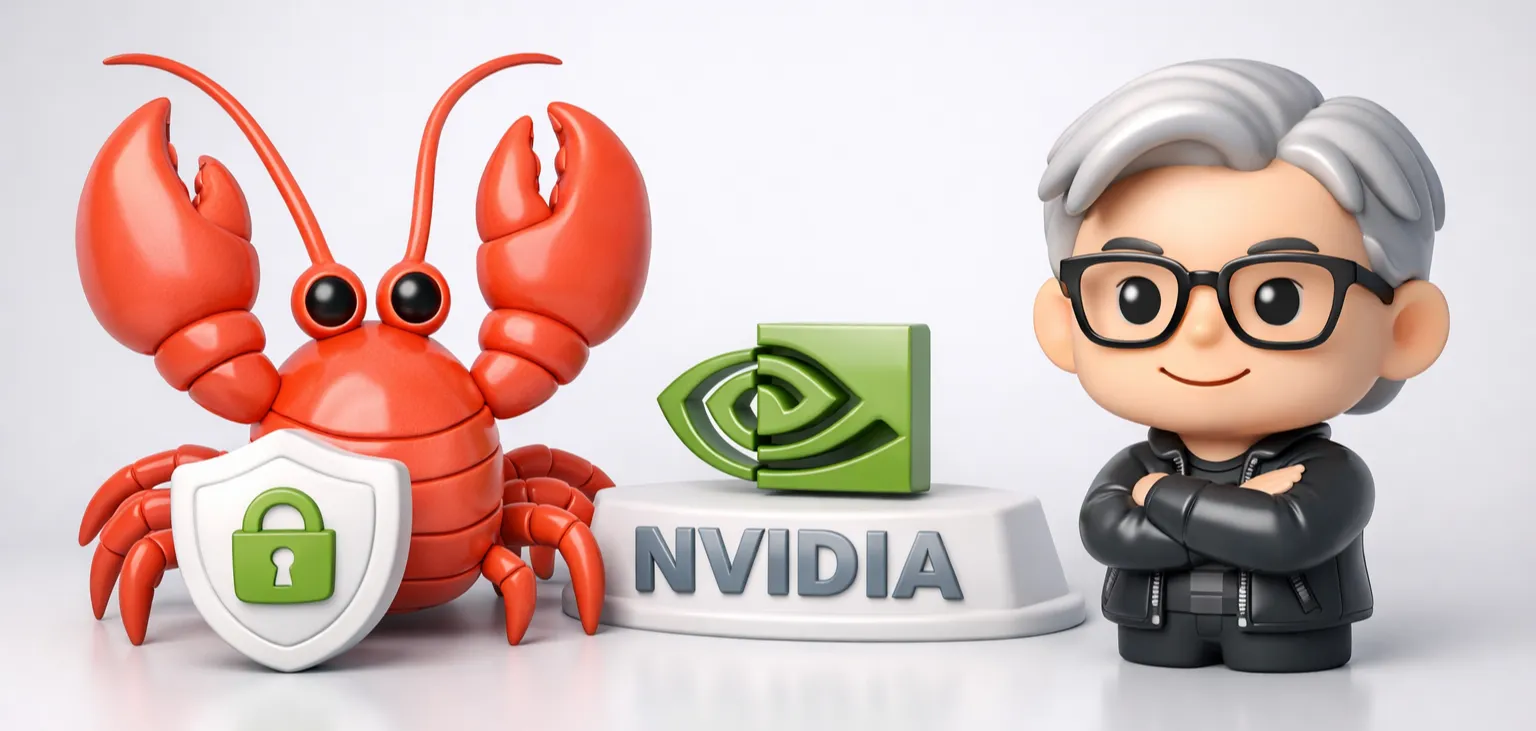
Just officially unveiled at NVIDIA GTC 2026, NemoClaw is basically NVIDIA’s way of making OpenClaw safer to run. It is not a whole new “AI employee” platform. It is better understood as a control layer that adds rules, monitoring, and security around OpenClaw. In simple terms, OpenClaw does the work, while NemoClaw helps decide what it can access, where it can connect, and how closely it is watched. That is why the smartest way to think about NemoClaw is this: it is a security and deployment layer for OpenClaw, not just another agent product.
What is NVIDIA NemoClaw, really?
If you search “What is NVIDIA NemoClaw”, you will probably see phrases like “enterprise AI agents,” “open source stack,” and “always-on assistants.” Those are not wrong, but they are also not the full story. The clearest official description is this: NemoClaw helps run OpenClaw more safely by installing NVIDIA OpenShell, applying policies, setting up inference routing, and managing the sandbox that the agent lives in. In other words, OpenClaw is the assistant you talk to; NemoClaw is part of the system that decides how much trouble that assistant is allowed to get into.
The official docs say NemoClaw has two main components: a TypeScript plugin that integrates with the OpenClaw CLI, and a Python blueprint that orchestrates OpenShell resources. That sounds technical, but the basic meaning is simple. One part provides commands and control points. The other part sets up the environment, policies, and inference plumbing behind the scenes. If that sounds less glamorous than “revolutionary agent platform,” good. It is also more accurate.
This is also why calling NemoClaw a full “platform” can be a little misleading. It has platform-like ambitions around deployment and control, but the official material points much more clearly toward a plugin + blueprint + sandbox model than toward a fully separate application universe. That is not a weakness. It just means the real value is in governance, not in pretending the underlying agent stack no longer exists.
NemoClaw vs OpenClaw: what’s the actual difference?
The easiest way to understand NemoClaw vs OpenClaw is this: OpenClaw is closer to the agent layer; NemoClaw is closer to the control layer. NVIDIA’s product page says NemoClaw adds privacy and security controls to OpenClaw. The docs say it sandboxes OpenClaw, routes inference through controlled backends, and manages lifecycle steps like blueprint versioning and sandbox setup. So if OpenClaw is the thing doing the job, NemoClaw is the system deciding where it can go, what it can call, and how closely it is watched.
That difference is not academic. It changes the whole risk model. An ordinary agent can be powerful and still be reckless. NemoClaw’s job is to make that recklessness harder. NVIDIA’s own description centers on OpenShell as a runtime that enforces policy-based security, network guardrails, and privacy guardrails for autonomous agents. So when enterprises ask, “What are the main differences between NemoClaw and OpenClaw?” the useful answer is not “one is better.” The useful answer is that one is about agent capability, while the other is about how that capability gets contained.
A simple metaphor helps here. OpenClaw is the teenager with a driver’s license. NemoClaw is the parent who says, “Fine, you can drive—but only this car, on these roads, with the location sharing turned on.” The teenager may still be dramatic. But at least someone put rules around the adventure. That is basically what the sandbox and policy model are doing.
How NemoClaw works
According to NVIDIA’s GitHub README and developer guide, NemoClaw installs the OpenShell runtime and uses a versioned blueprint to create a sandboxed environment where network requests, file access, and inference calls are governed by policy. The Nemoclaw CLI then orchestrates the whole thing: the OpenShell gateway, the sandbox, the inference provider, and the network policy. That is the heart of the system. It is not magic. It is structured supervision.
The docs also describe the sandbox as running with a strict-by-default network policy. In plain English, that means the agent does not get to call random outside services whenever it feels inspired. If the sandbox tries to reach an unlisted destination, OpenShell intercepts the request and prompts the operator to approve or deny it in real time. That is a big deal because one of the scariest parts of autonomous agents is not that they think; it is that they may act on systems and networks you actually care about.
On the filesystem side, the published protection layers say NemoClaw restricts reads and writes outside approved paths like /sandbox and /tmp, while process controls are meant to block privilege escalation and dangerous syscalls. The inference layer is also controlled: model calls are rerouted through approved backends rather than letting the agent spray requests everywhere. So the design goal is not “make the agent smarter.” It is “make the agent less likely to behave like a caffeinated intern with root access.”
What security features does NemoClaw provide?
If you are searching for “NemoClaw security features,” the official sources point to four core ideas: sandboxed execution, policy-based controls, operator-controlled network approval, and monitored inference routing. NVIDIA’s product page says OpenShell enforces policy-based privacy and security guardrails. The newsroom release describes OpenShell as an open source runtime that makes autonomous agents safer to deploy through policy, network, and privacy guardrails. The docs go further and show how this becomes strict network rules, real-time approval flows, and baseline policy files that can be customized.
There is also a visibility angle. The developer guide includes commands and monitoring pages for checking sandbox health, viewing logs, confirming the active provider and endpoint, and tracking blocked requests. That matters for enterprise use because “secure” is not just about blocking bad behavior. It is also about being able to see what happened when something weird goes wrong at 2 a.m. and your agent suddenly decides a harmless spreadsheet is a life mission.
That said, it is important not to oversell what NemoClaw does. Even NVIDIA’s own GitHub repo includes a very clear Alpha software warning: NemoClaw is early-stage, has rough edges, and should not yet be considered production-ready. So a fair reading is that NemoClaw improves runtime control and safety posture, but it does not magically solve every AI agent risk. You still need infrastructure discipline, policy design, testing, approvals, and operators who know what they are doing. In other words: the seatbelt is real, but you still should not drive off a cliff.
Is NemoClaw open source?
Yes. NVIDIA’s GitHub repository publishes NemoClaw under the Apache License 2.0, and the product page repeatedly describes it as open source. That matters because it tells you the stack is not being positioned only as a locked black box. It also helps explain why NVIDIA keeps pairing NemoClaw with OpenShell, Agent Toolkit, and Nemotron in a broader open-source story around autonomous agents.
But “open source” should not be confused with “simple” or “cheap.” Open source can mean transparency, inspectability, and flexibility. It does not mean your setup will be painless or that your team suddenly gets free enterprise-grade operations. In fact, the official prerequisites—Linux, Node.js, Docker, OpenShell, and configured inference backends—are a good reminder that free software and low total cost are not the same thing.
Can NemoClaw work with multiple cloud providers?
The honest answer is: it clearly supports multiple inference paths, but that is not exactly the same thing as being a mature multi-cloud abstraction layer. The developer guide shows that NemoClaw can switch inference providers at runtime, including NVIDIA Cloud, local vLLM, and local NIM. NVIDIA’s newsroom release also says developers can explore Agent Toolkit and OpenShell on inference providers and NVIDIA Cloud Partners such as Baseten, CoreWeave, DeepInfra, DigitalOcean, Together AI, and others. That is real flexibility.
At the same time, the product page still frames local, always-on deployment heavily around NVIDIA systems like GeForce RTX PCs and laptops, RTX PRO workstations, DGX Station, and DGX Spark. So if someone asks, “Can NemoClaw work with multiple cloud providers?” the careful answer is yes, there is evidence of backend and provider flexibility—but the official story is still very much told through NVIDIA’s ecosystem, tooling, and hardware strengths. That is not a contradiction. It is just the difference between “flexible” and “neutral.”
Is NemoClaw really hardware-agnostic?
This is where marketing shortcuts can get sloppy. Some third-party pages describe NemoClaw as effectively hardware-agnostic, but NVIDIA’s own published material is more nuanced. The docs prove that NemoClaw can route inference through cloud-hosted models, local vLLM for offline development, and local NIM services. That means the software is not trapped in one single execution pattern. But the product page still highlights NVIDIA hardware when discussing dedicated, always-on local deployments.
So the best answer to “NemoClaw hardware requirements” is not a dramatic yes or no. It is this: NemoClaw is flexible in how it routes inference and where parts of the stack can run, but the official deployment story remains strongly optimized around NVIDIA infrastructure. If you need perfectly neutral, everywhere-on-everything messaging, the current official materials do not really make that promise.
NemoClaw pricing: what does it actually cost?
Right now, “NemoClaw pricing” is a tricky search because there is no simple public SaaS-style price tag on the main product page or GitHub README. Instead, the official materials emphasize installation flow, local or cloud inference options, API keys, and infrastructure setup. That strongly suggests the practical cost is driven by the environment you build: compute, storage, monitoring, engineering time, and whichever inference backend you choose.
This is one of the most important decision points for enterprise readers. Open source often removes licensing anxiety and adds flexibility, but it can shift the bill toward operations. If you use NVIDIA Cloud inference, you are dealing with API-backed model access. If you use local vLLM or local NIM, you are shifting more responsibility onto your own infrastructure. The price question, then, is less “How much is NemoClaw?” and more “How much work do we want to own?” That is not as catchy as a pricing table, but it is a lot closer to the truth.
Why is NVIDIA building this?
NVIDIA’s public messaging around Agent Toolkit and OpenShell gives a pretty clear answer: the company sees the market moving from model demos toward autonomous, self-evolving agents that can actually act, use tools, and operate over time. In that world, the important question is no longer just whether a model can produce smart text. It is whether an agent can operate safely enough to be trusted with real enterprise work. That is why the official story keeps returning to policy, privacy, security, explainability, and runtime control.
There is also a practical ecosystem reason. NVIDIA’s newsroom release ties Agent Toolkit to Nemotron models, AI-Q, OpenShell, LangChain integration, and a long list of enterprise partners, including Adobe, Atlassian, Box, CrowdStrike, Salesforce, and others. So NemoClaw is not just a side project. It fits into a broader attempt to make NVIDIA important not only at the GPU layer, but also at the runtime and deployment layer for enterprise AI agents. That does not guarantee success, of course. But it explains why the company is investing in this part of the stack.
Who should actually care about NemoClaw?
NemoClaw is most relevant for teams that care about runtime control, security boundaries, and agent deployment architecture. If you are an engineering-heavy organization with DevOps or MLOps capacity, NemoClaw is interesting because it gives you a more transparent, policy-driven way to experiment with always-on agents. The official docs are full of knobs for setup, inference routing, policy changes, monitoring, and sandbox lifecycle, which is exactly the sort of thing infrastructure-minded teams want to inspect.
If, on the other hand, your team just wants working business outcomes next week, NemoClaw may be more “watch this space” than “deploy this by Friday.” NVIDIA’s own GitHub warning says the project is not yet production-ready, and even third-party explainer pages that are bullish on NemoClaw still frame it as a better fit for teams with real infrastructure resources and time to tune a self-hosted setup. That does not make it bad. It just means the practical buyer question is readiness, not excitement.
FAQ
What is NVIDIA NemoClaw?
NemoClaw is NVIDIA’s open-source stack and OpenClaw plugin for OpenShell, designed to run OpenClaw inside a sandboxed, policy-controlled environment with managed inference routing.
What are the main differences between NemoClaw and OpenClaw?
OpenClaw is the agent layer users interact with, while NemoClaw adds the control layer around it: sandboxing, policy enforcement, network restrictions, lifecycle setup, and managed inference routing.
What security features does NemoClaw provide?
The main published features are sandboxed execution, strict-by-default network policy, operator-controlled approval for blocked destinations, filesystem restrictions, process restrictions, and inference routing through approved backends.
Is NemoClaw open source?
Yes. NVIDIA publishes NemoClaw on GitHub under the Apache License 2.0.
How much does NemoClaw cost?
There is no simple public SaaS-style price on the main official materials. In practice, your costs are likely to come from infrastructure, inference, monitoring, and engineering time rather than from a neat per-seat software fee. That is an inference based on the official setup model and published prerequisites.
Can NemoClaw work with multiple cloud providers?
It clearly supports multiple inference paths, including NVIDIA Cloud, local vLLM, and local NIM, and NVIDIA’s broader Agent Toolkit story includes several cloud partners. But the official positioning still centers heavily on NVIDIA’s own ecosystem.
Final thoughts
NemoClaw is interesting for one simple reason: it treats AI agents less like magic and more like software that needs boundaries. That may not sound sexy, but in enterprise AI, the boring parts are often the parts that matter. Sandboxes, policies, logs, approvals, routes, restrictions—those are the things that turn “cool demo” into “maybe we can trust this in production someday.” NemoClaw is not there yet, and NVIDIA says as much. But the direction is clear, and it is much more useful than another round of empty “AI will change everything” confetti.
If this topic caught your attention, a smart next click on GStory is not another agent headline. It is a practical workflow guide. The same questions behind NemoClaw—control, privacy, monitoring, and safe automation—also show up in real media work. On GStory, the best follow-up internal links would be guides around AI video editing workflows, subtitle automation, and privacy-aware content processing. Those pages connect the “how do we control AI?” question to everyday creative work, which is where these ideas stop being buzzwords and start being useful.
Leave a Reply