Last Updated on December 30, 2025 by Xu Yue
You know that moment when your brain goes, “Wait… did I just see that?” and your thumb hovers over Share like it’s holding a live wire?
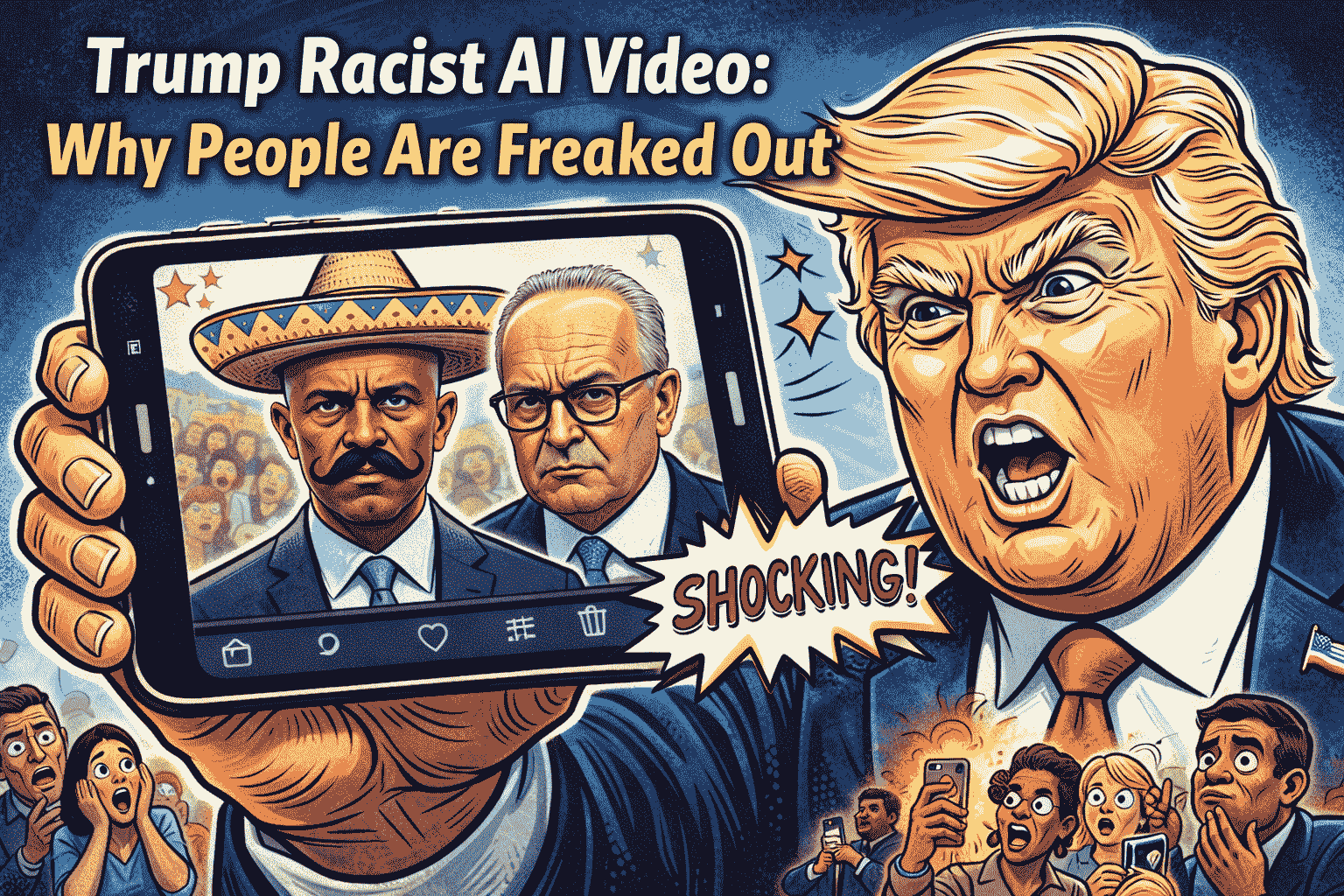
That’s the vibe around the Trump racist AI video controversy: not just “this is offensive,” but “oh no, this is going to break the internet’s ability to agree on reality.” In early October 2025, multiple outlets reported that President Trump posted AI-generated content targeting Democratic leaders Hakeem Jeffries and Chuck Schumer, including imagery widely criticized as racist caricature and fabricated audio, and the clips got pulled into the larger shutdown news cycle.
But the bigger story (and the reason people are so freaked out) is what the reactions reveal: the clip is basically a stress test for trust—political trust, media trust, and “can I believe my own eyes?” trust.
Trump Racist AI Video: The “This Changes Everything” Feeling People Can’t Shake
“If leaders post it, it gets normalized”
A recurring reaction in the Reddit threads wasn’t technical (“is this AI?”) so much as social:
- This isn’t some random troll.
- This is a person with a massive platform.
- If they post it, millions will treat it like acceptable discourse.
That “the bar just moved” feeling shows up again and again—people comparing it to behavior you’d expect a school to punish, not a head of state to promote.
“You can manufacture ‘evidence’ now”
Here’s the fear in plain English: once AI can generate a believable clip, the clip can be used as “proof” in someone’s mind—even if it’s labeled as fake later.
You’ll see commenters say some version of: “They don’t even need to say it anymore—they can generate it.” That’s not a partisan point. It’s a media reality point.
“Even if it’s fake, it still shapes beliefs”
This is the part people underestimate. “It’s fake” doesn’t mean “it has no impact.”
A clip can still:
- harden stereotypes,
- create a sticky “association” (even after debunking),
- and keep circulating as trump memes that outlive the original context.
That’s why the emotional response is bigger than the clip itself: people aren’t only reacting to what it shows, but to the idea that the information environment is getting easier to poison.
Why This Specific Clip Hits So Hard
News coverage described the clip(s) as depicting Jeffries with stereotypical imagery (including a sombrero and mariachi-style audio cues), while also using fabricated audio involving Schumer—elements that critics called racist and bigoted and defenders framed as humor.

Visual stereotype shortcuts
Caricature is viral because it’s instant. It doesn’t require context, evidence, or patience.
Your brain processes:
- costume + music cue + exaggerated features
faster than it processes: - “here’s a 900-word policy explanation.”
That’s why this kind of edit spreads like wildfire: it compresses a message into a visual punchline.
Context hijacking: attaching a viral edit to a high-stakes moment
This also landed during a government shutdown moment, so the clip didn’t live in a vacuum—it got stapled to a breaking-news storyline. Reuters and others reported that the controversy unfolded alongside shutdown negotiations and press interactions, which amplified the reach and stakes.
That’s “context hijacking”: when a meme-like clip becomes the thing people argue about, instead of the underlying issue.
Trump Memes vs Deepfakes: The “It’s Just a Joke” Trap
The internet loves a loophole. The favorite loophole here is: “Relax, it’s just a meme.”
Sometimes that’s true! Satire is a real genre. But it’s also a convenient disguise for manipulation.
Satire signals vs manipulation signals (what changes the risk)
A quick way to tell trump memes (satire-ish edits) from something closer to a deepfake/info attack is intent + transparency:
More satire-like signals
- Clear labeling (“parody,” “AI,” “edited”)
- Doesn’t impersonate real speech as authentic
- Jokes about ideas, not dehumanizing traits
More manipulation-like signals
- Sounds like “real audio” but isn’t
- Cropped context so viewers can’t verify
- Designed to be shareable rage-bait
- Leaves plausible deniability (“I was kidding”)
In this case, multiple reports explicitly describe fabricated audio being part of the controversy—an extra reason people reacted strongly.
The “meme defense” playbook that keeps harmful edits circulating
Even when everyone knows something is altered, it can keep spreading because:
- “It’s funny”
- “They deserve it”
- “People are too sensitive”
- “It’s obviously fake, so it’s harmless”
But “obviously fake” doesn’t stop a clip from shaping attitudes—especially when it’s reposted without context across platforms.
Trump AI Video Schumer: Fabricated Audio and the New Trust Crisis
People often treat deepfakes like a video-only problem. But in practice, audio is the cheat code.
That’s why searches like trump ai video Schumer spike: people want to know what was edited and how to tell.
Why fabricated audio is harder to notice than visual edits
Visual deepfakes can show obvious glitches: weird teeth, odd blinking, waxy skin.
Audio can be subtler:
- cadence that’s slightly “too smooth,”
- emphasis that feels off,
- mismatched breath patterns,
- unnatural pacing around names or emotional words.
And crucially: people often listen to audio while scrolling, not in “analysis mode.”
Mainstream reporting on this episode emphasizes that fabricated audio was part of what made the clip inflammatory and confusing.
The “liar’s dividend”: when real footage gets dismissed as fake
Here’s the nightmare loop:
- AI fakes become common →
- Everyone gets skeptical →
- Then powerful people can deny real evidence by saying “AI.”
Researchers and policy analysts call that the liar’s dividend: the benefit someone gets when the public can’t tell what’s real anymore.
So yes—deepfakes can trick people. But just as damaging: deepfakes can make people stop trusting authentic media.
Trump’s Racist Fake Video: A 5-Minute Verification Checklist Before You Share
Let’s make this practical. If a clip like trump’s racist fake video lands in your DMs, do this before you repost, quote-tweet, or “stitch” it.
Source tracing
1) Find the earliest upload you can.
Not “who posted it to your timeline,” but the earliest timestamped post you can locate.
2) Check whether mainstream outlets describe it the same way.
For this incident, Reuters/ABC/Guardian reporting aligns on key claims: it was posted by Trump, depicts Jeffries with stereotypical imagery, and involves fabricated audio targeting Schumer.
3) Watch for “re-upload edits.”
Re-uploads often remove labels, add new captions, or crop out disclaimers.
Reality checks
4) Look for audio-video mismatch.
Do mouth movements and syllables line up? Are breaths natural?
5) Listen for “too clean” audio.
If it sounds like studio voiceover on top of chaotic footage, pause.
6) Scan for frame jumps.
Hard cuts can hide splicing.
Cross-confirmation
7) Cross-check with at least two credible reports.
Not because “the media is always right,” but because independent confirmation reduces your odds of being manipulated.
If you want a bigger-picture reason: institutions like NIST run media forensics work on detecting AI-generated deepfakes because the technical problem is real—and getting harder.
What to Do If You’ve Seen or Shared the Trump Racist AI Video
Okay—maybe you already shared it. Or you screenshotted it. Or you replied with a spicy caption and now you regret everything.
Here’s the cleanest damage-control path.
How to correct without re-amplifying
- Don’t re-post the full clip in your correction.
- Use a still image with the key claim explained.
- If you must reference visuals, blur the main frame so it can’t play as entertainment bait.
How to talk about it without boosting it
Try language like:
- “This clip is AI-generated / manipulated”
- “Multiple outlets report it includes fabricated audio”
- “Here’s what’s verified vs not verified”
And link to a credible explainer, not the original viral upload.
If you’re posting commentary, add clear context captions (what’s verified / what isn’t) with subtitle generator and, if needed, localize that context using video translator.
When to report vs when to disengage
Report when the post:
- impersonates someone speaking,
- presents AI content as authentic,
- targets protected groups with dehumanizing stereotypes,
- or is being used to harass individuals.
Disengage when:
- replies are pure bait,
- there’s no shared reality to work with,
- your correction is turning into free distribution.
Comment sections “melt down” because AI clips turn every thread into two fights at once:
- the political fight, and
- the reality fight (“is this even real?”).
That second fight is exhausting—and it’s exactly why people are freaked out.
Leave a Reply